
Basement Storage Ideas: 15 Ways to Keep Things Dry and Easy to Find
Published · 9 min read
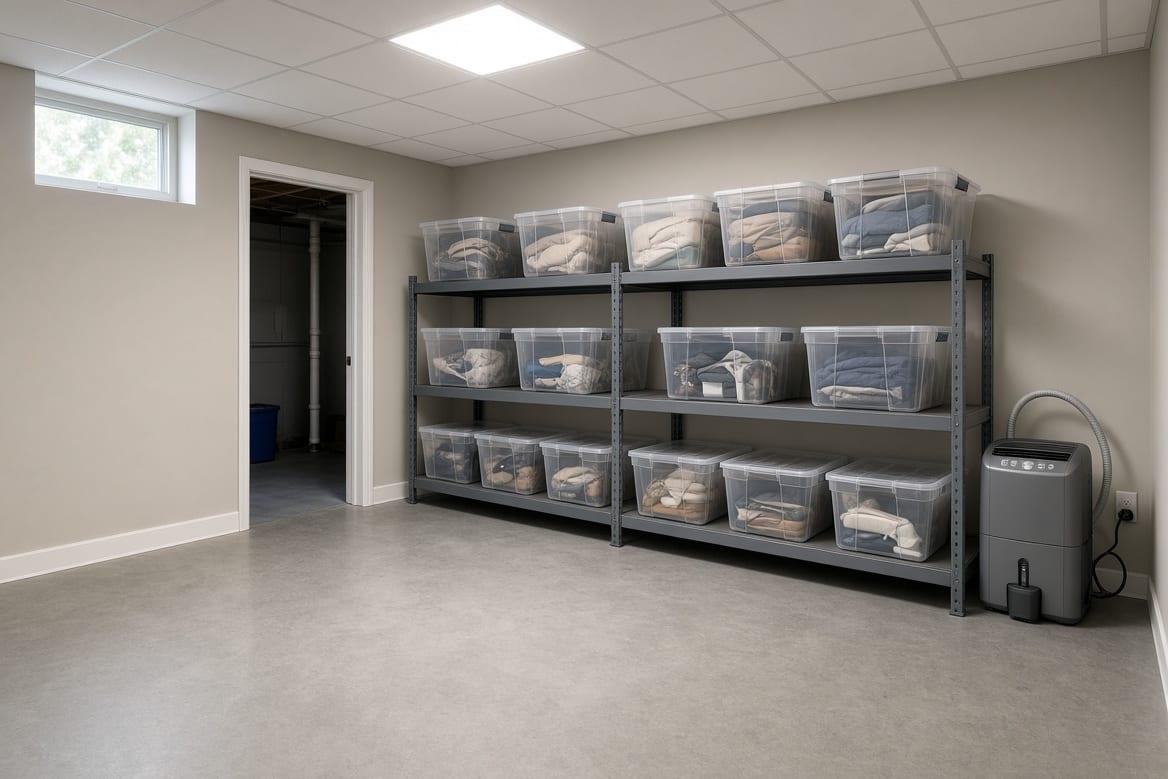
Basement storage ideas start with water, not shelves. A basement is the biggest storage space in many homes, and the one most likely to be damp, to flood a little every few years, or to smell of mildew by August. Get the water part right and everything else is ordinary organizing.
This guide covers how to keep basement storage dry, how to organize a basement in a weekend, 15 basement storage ideas for shelves, walls and corners, and what not to keep down there at all.
Basement storage starts with keeping things dry
Even a basement that has never flooded is usually cooler and damper than the rest of the house. Cool air holds less water, so things stored against cold walls and floors pick up moisture. Four habits deal with most of it:
- Raise everything off the floor. Nothing sits on the concrete, not even for a week. Put the lowest shelf at least 15 cm (6 inches) up, or stand bins on pallets or plastic risers. When a pipe leaks or water comes in, it reaches the floor first.
- Plastic, not cardboard. Cardboard soaks up damp, sags, grows mold and draws silverfish. Lidded plastic totes keep water and pests out. Move things out of their moving boxes before they go down.
- Run a dehumidifier. The EPA suggests keeping indoor humidity below 60 percent, ideally between 30 and 50 percent. A cheap hygrometer tells you where you are, and a dehumidifier with a hose to a drain empties itself.
- Keep off the exterior walls. Outside walls are the coldest and dampest surfaces. Leave a gap of a few centimeters (an inch or two) between shelving and the wall, so air can move behind it.
If water comes in after heavy rain, fix that first: gutters, downspouts that drain away from the house, and the grading around it. Storage can't solve a wet basement.
Unfinished vs finished basement storage
An unfinished basement has bare concrete, open joists and usually the furnace and water heater. It's utility storage: metal or plastic shelving, lidded totes, tools and the things you use once a year. The open joists overhead are useful too (more on that below).
A finished basement has walls, flooring and heat, so it's closer to a room in the house. Here storage can be built-in cabinets, a closet under the stairs, or a wall of shelving behind doors. It's still below ground, so the same rules apply: nothing on the floor that water can ruin, and a dehumidifier in summer.
Many basements are both: a finished family room and an unfinished utility side. Put the long-term storage on the utility side and keep the finished side for things you use.
How to organize a basement in a weekend
- Check for water first. Look for tide marks on the walls, white powder on the concrete and rust on old shelf legs. If you find any, raise storage higher and run the dehumidifier before anything goes back.
- Take everything out, one area at a time. A basement is often too big to empty at once. Do one wall or one corner per session.
- Sort: keep, donate, sell, toss. Basements collect things nobody decided about. If it has been down there since you moved in and you didn't miss it, let it go. Declutter and sell has a routine for the sell pile.
- Move everything into lidded plastic totes. Same size where you can, so they stack and swap places.
- Plan zones. Each kind of thing gets its own area (see below), with the ones you use most nearest the stairs.
- Number the totes and list what's in them. A basement is where you most need to know what's in a bin without carrying it upstairs. The last part of this guide shows how.
Basement storage zones
- The stair zone. Things you fetch often: spare paper towels, bulk groceries in sealed containers, the vacuum.
- Household overflow. Spare kitchen things, extra bedding in sealed bags, the folding table and chairs for guests.
- Seasonal. Holiday decorations, summer or winter clothes in sealed totes, camping and beach gear.
- Paint and DIY. Paint, fillers, brushes and the drill, on a shelf away from the furnace.
- Long-term. Things you keep but rarely open: the kids' outgrown clothes, tax papers in a waterproof box, a keepsake tote. These go furthest from the stairs, on the higher shelves.
Leave a clear path to the stairs, and keep the space around the furnace, water heater, electrical panel and water shutoff empty. You need to reach them in a hurry, and the furnace and water heater need air.
15 basement storage ideas
Shelving and totes
- Freestanding metal shelving. It doesn't rot, it's easy to wipe, and wire shelves let air through. Plastic shelving works too in a damp basement.
- Matching lidded totes. One size on every shelf, so a tote from the top fits the bottom. Clear ones where you open them often, solid ones for long-term storage.
- A bottom shelf that stays empty, or holds only plastic. If water ever comes in, it's the shelf that gets wet.
- One tote per job. "Christmas", "Beach", "Paint and DIY", "Guest bedding". Mixed totes are where things disappear.
- Number every tote. A big number on the end, readable from the stairs. It stays right even when what's inside changes. Storage bin labels covers what to write and where.
Walls and ceiling
- Shelving along interior walls first. They're drier than outside walls. If you must use an outside wall, leave a gap behind the shelves.
- Shelves between open joists. In an unfinished basement, boards or rails across the joists hold long, light things: wrapping paper, curtain rods, fishing rods.
- Ceiling hooks for awkward things. A folding chair, a sled or a bike hung from a joist frees floor space.
- Pegboard above a workbench. If the basement is your workshop, tools on hooks stay in sight and off damp surfaces.
Under the stairs and corners
- Under the basement stairs. Rolling bins or a short shelf fit the triangle under the steps. See under-stairs storage ideas for more.
- A corner shelf for cleaning supplies. Mop, bucket and refills in one place near the laundry.
- A rolling cart for paint. Cans, brushes and tape go where the job is, and roll back.
Keeping it dry and clean
- Vacuum-sealed bags for fabric. Bedding and clothes in sealed bags inside a lidded tote keep damp and moths out.
- Moisture absorbers inside totes. A sachet of silica gel or a moisture absorber in each tote of fabric or paper helps in a basement that runs damp.
- A hygrometer by the stairs. Check it as you pass. If humidity creeps up, empty or move the dehumidifier before anything starts to smell.
What not to store in a basement
Some things don't survive damp, cool air, or a few centimeters of water. Keep them upstairs, in a closet inside the house:
- Paper, books and documents. They take up moisture, curl and mildew. If tax papers must go down, use a waterproof box on a high shelf.
- Photos and artwork. Prints stick together and spot in damp. Keepsakes you can't replace belong in the driest room you have.
- Fabric that mildews. Leather, wool, upholstered furniture, mattresses and clothes in open boxes. Only in sealed bags and totes, if at all.
- Food that draws pests. Flour, cereal, pet food and birdseed in bags bring mice and insects. Sealed tins and jars on a shelf are fine; anything in paper or thin plastic isn't.
- Electronics in a damp basement. Damp corrodes contacts and boards. Old computers, cameras and game consoles keep better upstairs.
- Anything flammable near the furnace or water heater. Paint thinner, gasoline and aerosols stay well away from anything with a flame or a pilot light.
Find anything in your basement later
The worst part of basement storage is the stairs. You carry a tote up to check whether the waffle iron is in it, and it isn't. Hoardo is a free app that keeps a list of what's in every tote, so you check on your phone first and carry up only the right one.


- Make a room for the basement in Hoardo. If it has a finished and an unfinished side, make one for each.
- Add each tote and shelf as a numbered box, with the number you wrote on it.
- List what's inside. Type it, say it, or take a photo of the open tote and let Hoardo list what it sees.
- Print QR labels on plain paper, sticker sheets or a label printer. Scanning one with your phone's camera opens that tote's list.
Then the waffle iron is a search, not a trip up and down the stairs. Hoardo shows the tote, its number and the room, and a photo of each thing if you took one.
Share the basement with your family, and anyone can look before they go down. For the other storage spaces, see attic storage ideas, garage organization and the full list of storage ideas for every room.
Questions about basement storage
How do I keep things dry in basement storage?
Keep everything off the floor on shelving or pallets, use lidded plastic totes instead of cardboard, and leave a gap between shelves and outside walls. Run a dehumidifier: the EPA suggests keeping indoor humidity below 60 percent, ideally between 30 and 50.
Is it OK to store cardboard boxes in a basement?
Not for long. Cardboard soaks up damp, sags, grows mold and draws silverfish and mice. Move things into lidded plastic totes before they go down, and recycle the boxes.
What should you not store in a basement?
Paper, books and photos, which mildew and stick together; leather, wool and upholstered things; food in bags, which draws pests; and electronics if the basement is damp. Keep anything flammable well away from the furnace and water heater.
How do I organize an unfinished basement?
Put freestanding metal or plastic shelving along the interior walls, with the lowest shelf off the floor. Give each kind of thing its own zone, keep the space around the furnace, water heater and electrical panel clear, and use the open joists for long, light things.
How do I find things in basement storage bins?
Number every tote and keep a list of what's in each one. In Hoardo the basement is a room and every tote a numbered box with its contents listed, with photos if you like. Search shows which tote the waffle iron is in before you go down the stairs.
Is Hoardo free?
Yes. Hoardo is free, with every feature included: rooms, numbered boxes, QR labels, search and sharing with your family. There's no paid plan.