
Under Stairs Storage Ideas: 16 Ways to Use the Space
Published · 8 min read
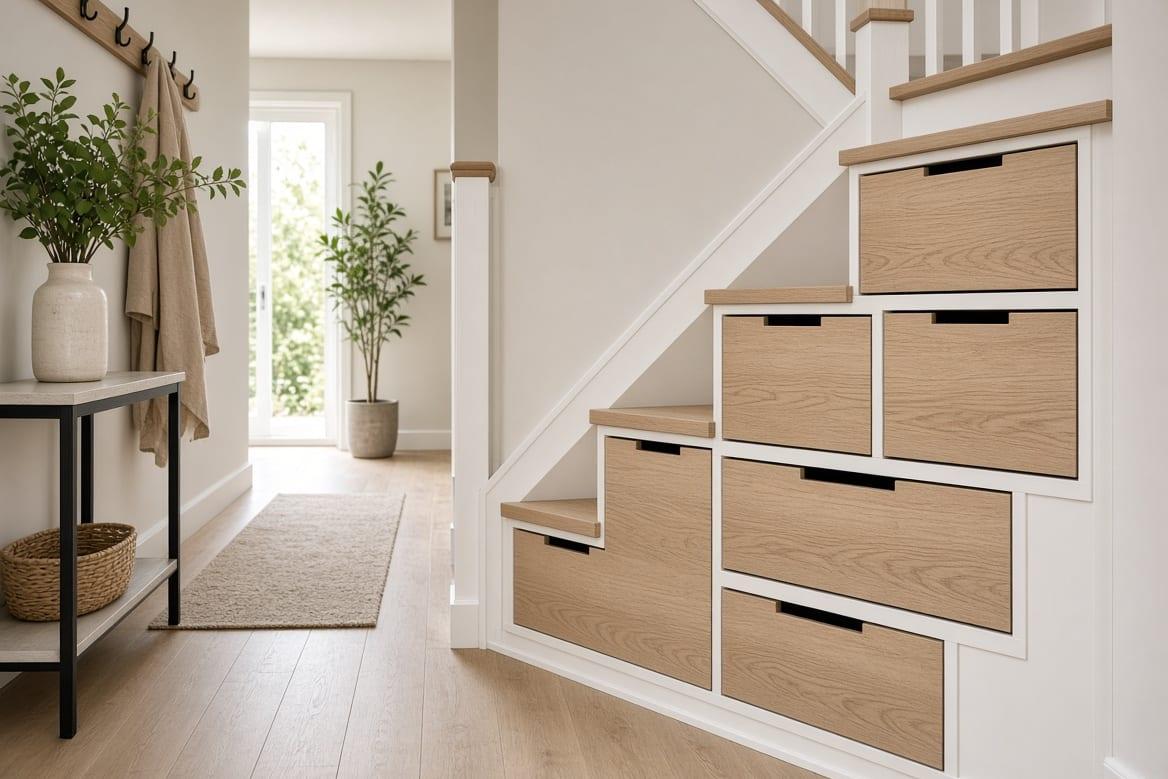
The best under stairs storage ideas start with the shape. The space is tall at one end, low at the other and deep, which makes it great for storage and terrible for finding things. Whatever goes in first ends up at the back, under the lowest step, and nobody sees it again until you move house.
This guide covers how to plan the space, 16 under stairs storage ideas, from open shelves and closed cupboards to pull-out drawers and a nook with a desk, a reading corner or a dog bed, what to keep there and what not to, and how to find things in a deep cupboard.
How to plan your under-stairs space
- Measure it. The height at the tall end, the height at the low end, the depth and the width. Draw it on paper. The low end is often less than 60 cm, 2 feet, and that changes what fits.
- Decide what it's for. Storage, a nook, or both. A cupboard full of coats and a reading corner don't share well.
- Check what's behind the wall. Pipes, wiring, the electricity meter or the fuse box. Anything you need to reach stays reachable.
- Use the depth, not just the front. A deep space needs things that come out to you: drawers, rolling bins, a pull-out rack. Things you have to reach past other things are where the trouble starts.
- Put the tall things at the tall end. The vacuum, the ironing board, long coats. Short bins and drawers go under the lower steps.
- Number the bins and keep a list. In a deep cupboard, a list is how you find things without emptying it. The end of this guide shows how.
16 under stairs storage ideas
Open under-stairs storage
- Open shelves that step down. Shelves that follow the stairs, deeper or shorter as the steps come down, for books, baskets and display.
- Cubbies. A grid of square spaces takes baskets that come out one at a time.
- A bench with hooks above. If the stairs face the front door, the space under them becomes the entryway: a bench to sit on, hooks for coats and shoes beneath. See shoe storage ideas for that part.
- Wine or bottle racks. A rack shaped to the stairs uses the odd corners nothing else fits.
Closed cupboards
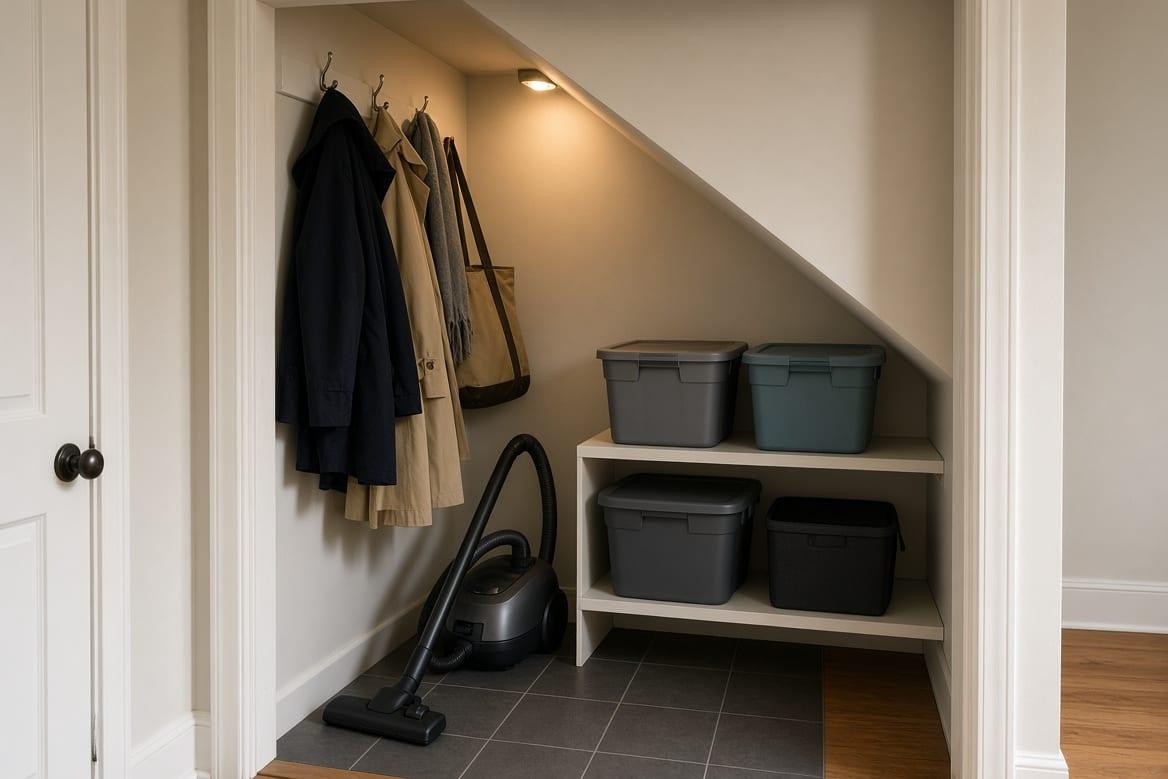
- A cupboard with a light. A deep cupboard without a light is a cupboard you search with your phone. A battery light with a motion sensor needs no wiring.
- Hooks on the inside of the door and the side walls. Coats, bags, the dog's leash and the broom, off the floor.
- A shallow shelf on the back wall. At the tall end, a shelf at head height for things you need often.
- Lidded bins on low shelves. Same-size bins with a number on the front, so you pull out the right one without moving the others.
- A rolling bin for the low end. The space under the lowest steps is where things vanish. A bin on wheels pulls it out to you.
Pull-out drawers
- Drawers that follow the steps. Built-in drawers of different heights, deep enough to hold a lot. The most useful under-stairs storage there is, and the most work to fit.
- A pull-out coat and shoe rack. A tall drawer on runners at the tall end, with a rail for coats and shelves for shoes. It slides out, so you never reach to the back.
- A pull-out pantry. Next to a kitchen, the same idea with shelves for cans and dry food.
A nook
- A small desk. With a shelf above it and a light, the tall end fits a home office for a laptop and a chair. Check the height where you'd sit.
- A reading corner. A cushion, a lamp and a shelf of books. Children love a low, enclosed space.
- A pet bed. A dog or cat bed under the stairs, with a hook for the leash and a bin for food and toys beside it. Keep the food bin closed.
- A laundry or utility corner. If the plumbing allows, some homes fit a compact washer under the stairs, with a cupboard for detergent above.
Built-in or freestanding?
Built-in drawers and cupboards made to the shape of your stairs use every inch, and they look like part of the house. They're also the most expensive option and the hardest to change. Freestanding storage, like shelves, a cube unit, rolling bins and a coat rack, costs less, goes in this weekend and moves with you.
A good middle way: start freestanding. Live with it for a few months and see what you actually keep there and how often you open it. If you then build in, you'll know which drawers need to be deep, which can be shallow, and whether the tall end is for coats or a desk.
Whichever you pick, check two things first. If the space is against an outside wall or over a damp floor, raise bins off the floor on a shelf or a slatted base and leave a small gap at the back so air can move. And if it's a cupboard with a door, leave a gap or a vent so it doesn't get musty.
What to keep under the stairs
The space is dry and inside the house, which makes it better than a garage or a basement for many things.
- Cleaning things: the vacuum, mop, bucket, spare vacuum bags and mop heads.
- Spare bedding and towels, in lidded bins or zip bags.
- Coats, bags and shoes that don't fit by the door.
- Seasonal things you need a few times a year: fans in winter, a heater in summer, the picnic basket.
- Gift wrap, the sewing kit, the toolbox for small jobs.
- Board games and puzzles, if the space is near the living room.
- The emergency bag, near the front door and easy to grab. The emergency kit checklist has what goes in it.
Group them the same way as anywhere else: one bin per job, things used together stored together, the everyday at the front and the once-a-year at the back under the lowest step.
What not to keep there
- Anything that burns easily, if the stairs are your way out of the house in a fire: paint, solvents, piles of paper and cardboard. Keep the space under an escape route as clear of fuel as you can.
- Food that draws pests, unless it's in sealed containers.
- Things that need checking often, at the very back. If you open it weekly, it goes at the front.
- Anything in front of the meter, the fuse box or a water shut-off valve.
Find things in a deep cupboard
A deep under-stairs cupboard holds a lot, and that's the problem: things vanish at the back. Hoardo fixes that part. It's a free app where every bin, shelf and drawer is a numbered box with a list of what's inside, so you find things by searching, not by crawling in with a flashlight.

- Make a room for the space under the stairs.
- Add each bin, shelf and drawer as a numbered box, with the number you wrote on it. The cupboard itself can be a box too, with bins inside it.
- List what's inside. Type it, say it, or snap a photo of the open bin and let Hoardo list what it sees.
- Print QR labels on plain paper, sticker sheets or a label printer. Scanning one with your phone's camera opens that bin's list.
When guests are coming, a search for "pillowcases" shows the tote and where it is. And a low-quantity alert on the vacuum bags tells you when you're down to the last one, before the vacuum does. For the rest of the house, see closet storage ideas, storage bin labels and storage ideas for every room.
Questions about under stairs storage
What is the best way to use the space under the stairs?
It depends on the space and the room it opens onto. Pull-out drawers use the full depth best, a cupboard with hooks and bins is the simplest, and by the front door it can be the entryway with a bench and coat hooks.
What can I store under the stairs?
Cleaning things, spare bedding and towels, coats and shoes, seasonal things like fans and heaters, gift wrap and board games. Keep what you use often at the front and the tall things at the tall end.
What should you not store under the stairs?
If the stairs are your way out in a fire, keep things that burn easily away from them: paint, solvents and piles of paper or cardboard. Don't block the meter, the fuse box or a water shut-off valve.
How do I stop things getting lost at the back of an under-stairs cupboard?
Use things that come out to you, like rolling bins and pull-out racks, add a light, and number the bins. In Hoardo each bin is a numbered box with its contents listed, so you search for the pillowcases instead of emptying the cupboard.
Can I put a desk under the stairs?
Yes, at the tall end, if there's room to sit without hitting your head. Measure the height where the chair goes, add a shelf above and a light, and keep cables tidy along the wall.
Is Hoardo free?
Yes. Hoardo is free, with every feature included: rooms, numbered boxes, QR labels, search and sharing with your family. There's no paid plan.