
Shoe Storage Ideas: 22 Ways to Store Shoes in Any Space
Published · 8 min read
Good shoe storage ideas start with a count. Most homes have more shoes than places for them, so they end up in a pile by the door, half of them out of season and a few that nobody has worn in years. Give the shoes you wear every day a spot by the door, put the rest away by season, and the pile goes.
This guide covers how to sort your shoes, 22 shoe storage ideas for the entryway, the closet, small spaces, boots and kids' shoes, how to store shoes you won't wear for months, and how to know where the snow boots are when the first snow comes.
How to organize your shoes
- Gather every pair in one place. From the hall, the closets, under the beds and the car. Count them. Most people are surprised.
- Sort into keep, donate, repair and toss. Keep what fits and what you've worn in the last year. Shoes that pinch won't stop pinching. A good pair with a worn heel goes to the repair pile, not back in the closet.
- Split what's left into everyday, occasional and out of season. Everyday shoes are the two or three pairs each person wears this week. Occasional shoes are for weddings, hiking or the gym. Out of season is the snow boots in summer and the sandals in winter.
- Give each group a place. Everyday shoes by the door, occasional shoes in the bedroom closet, out-of-season shoes in boxes on a high shelf or in a hall closet.
- Set a limit for the door. Two pairs per person is a good start. The rest go where they live.
- Label the boxes and keep a list. A closed box needs a label, and a list is how you find the right box later. The end of this guide shows how.
22 shoe storage ideas
Entryway shoe storage
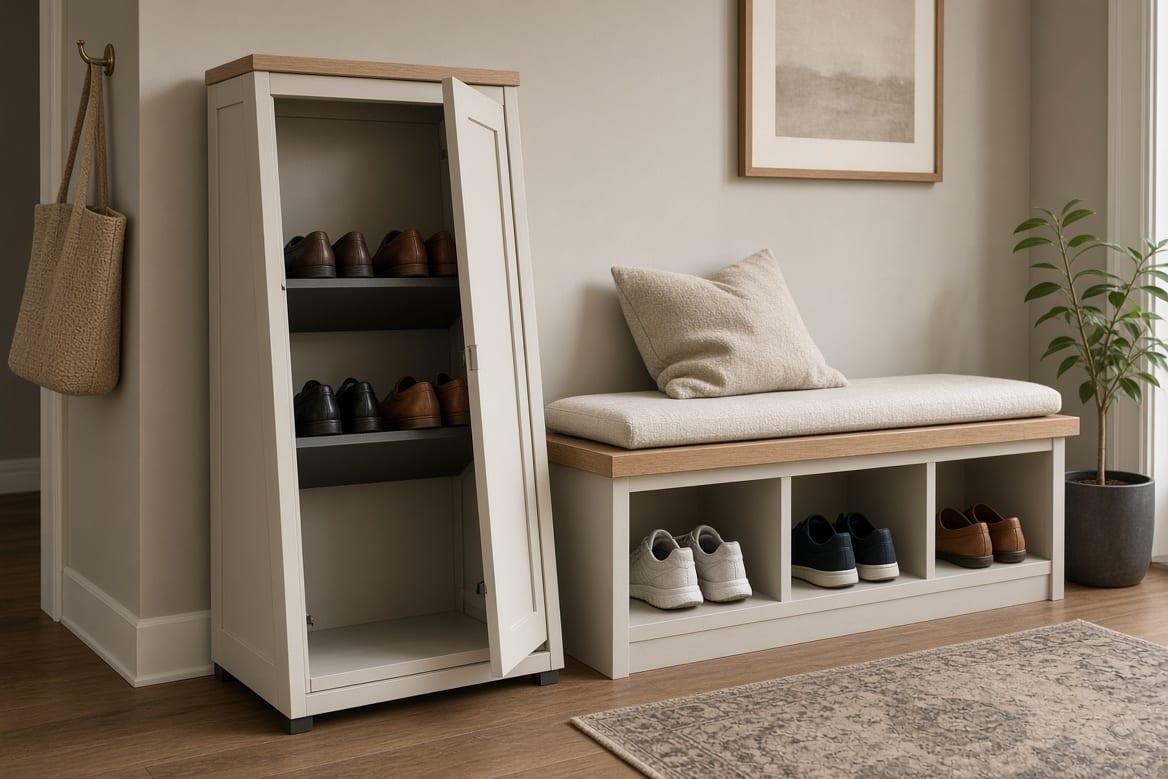
- A tilt-out shoe cabinet. Shallow, about 20 to 25 cm, 8 to 10 inches deep, with doors that tip forward. It fits a narrow hall and hides the pile.
- A bench with cubbies or a shelf underneath. A place to sit while you pull boots on, with shoes below.
- A boot tray. A rubber or metal tray by the door catches snow, mud and water before it reaches the floor.
- A shoe rack with a top shelf. Shoes below, keys, gloves and the dog leash on top.
- A basket per person. Kids' sneakers and sandals land in their own basket, not across the hall.
- Hooks above for bags and coats. If the bags have their own hooks, the bench stays free for sitting.
Closet shoe storage
- A two-tier shoe shelf on the closet floor. Twice the shoes in the same floor space.
- Shoes on a shelf, heel to toe. Store one shoe facing forward and one backward, and a pair takes less width.
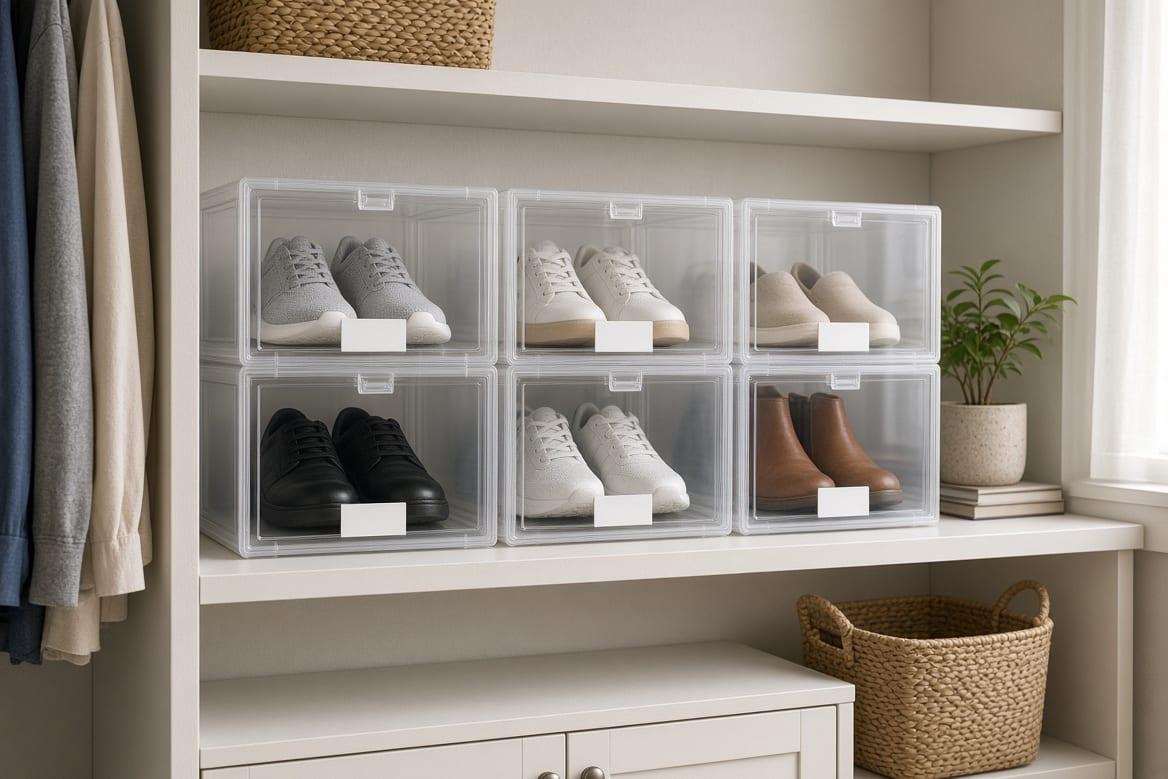
- Clear drop-front shoe boxes. They stack, you see what's inside, and the front opens without lifting the box above.
- An over-the-door organizer. Clear pockets for flats, sandals and slippers. Not for heavy boots or tall heels.
- Slanted shelves. Angled shelves with a lip show the whole shoe and take up less depth than flat ones.
- A photo or a label on the end of each box. Original shoe boxes are fine if you can tell them apart without opening them.
Shoe storage for small spaces
- Under the bed. A low, lidded or rolling bin with dividers holds 8 to 12 pairs where nothing else would go.
- Up the wall. Narrow wall shelves or rails, one row at a time, keep shoes off the floor in a tiny hall.
- Behind the door. A door organizer or a hanging rack on the back of a closet or bedroom door.
- A stacking rack. Modular racks that stack to the height you have, and grow when you need another row.
- A storage ottoman. A seat by the door with shoes inside it.
Boots
- Boot shapers or rolled magazines. Tall boots slump and crease at the ankle. Something inside keeps them upright.
- Boot hangers. Clips on a hanger hold boots by the top, on the closet rod, off the floor.
- A low shelf for rain and snow boots. Wet boots need air to dry, so a tray or open shelf, not a closed box, until they're dry.
Kids' shoes
- Low, open storage they can reach. A cubby or basket at their height means they put shoes away themselves.
- A box for the next size up. Hand-me-downs and shoes bought on sale go in one box, sorted by size, so they're found when feet grow, not after.
How to store shoes for the off-season
Shoes you won't wear for months need a little care before they go away.
- Clean them first. Mud and salt damage leather over time, and dirt draws pests.
- Dry them completely. Damp shoes in a closed box get musty or moldy.
- Stuff them. Tissue paper or shoe trees keep the shape. Cedar shoe trees also absorb moisture.
- Use breathable storage for leather. Fabric shoe bags or a cardboard box. Airtight plastic can trap moisture.
- Keep them somewhere dry and not too warm. An attic that gets hot in summer can dry out leather and soften glue. A hall closet or a shelf in a bedroom closet is better.
- One box per season and per person. "Winter boots", "Party shoes", "Kids' sandals". Then number the box.
Shoe storage for a family
A family's shoes multiply by the door faster than anyone's. A few habits keep them in check:
- A spot per person. One cubby, basket or shelf each, at a height they can reach. Kids put shoes away when the place is theirs and it's easy.
- Everyday shoes only by the door. School shoes, sneakers and the current boots. Sports cleats, dance shoes and party shoes live in each person's room or in a box in the closet.
- A check at each change of season. Kids' feet grow. When the weather turns, try on last year's boots before the first cold morning, and move what's too small to the hand-me-down box or the donate bag.
- A box for the next size. Shoes that will fit next year go in one box, with the size on the list, so they're used and not found two sizes too late.
- A place for wet shoes. A tray or a mat by the door that's only for wet and muddy shoes, so they dry before they go back with the rest.
Watch out for
- Shoes on the floor of a damp basement. They're the first to get musty.
- Heavy boots in an over-the-door organizer. It will pull the door out of shape or tear.
- A pile that grows past the limit. If the rack by the door is full, shoes go back to the closet, not on top of the rack.
Find the snow boots in November
The everyday shoes are by the door. The trouble is the rest: the boots in a box since March, the dress shoes you wear twice a year, the kids' next size. That's what Hoardo is for: a free app where every shoe box, bin and shelf is a numbered box with a list of what's inside.


- Make a room for each place shoes are stored, like the hall closet or the bedroom closet.
- Add each box as a numbered box, with the number you wrote on its end.
- List the pairs inside. Type them, say them, or snap a photo of the open box and let Hoardo list what it sees. Add a photo of each pair if the boxes look alike.
- Print QR labels for the boxes on plain paper, sticker sheets or a label printer. Scanning a label with your phone's camera opens that box's list.
When the first snow comes, search "boots" and Hoardo shows the box and the closet. When the season ends, the sandals go into the box the boots came out of, and you change the list. For the rest of the closet, see closet storage ideas, under stairs storage ideas and storage ideas for every room.
Questions about shoe storage
How do I store a lot of shoes in a small space?
Go up and under: stacking racks, narrow wall shelves, an over-the-door organizer and a low bin under the bed. Store pairs heel to toe to save width, and keep only the shoes you wear this season out at all.
What's the best shoe storage for an entryway?
A shallow tilt-out shoe cabinet if the hall is narrow, or a bench with cubbies underneath if there's room to sit. Add a boot tray for wet shoes and a limit of about two pairs per person by the door.
How do you store boots so they keep their shape?
Put boot shapers or rolled paper inside tall boots so they stand upright, or hang them from boot clips on the closet rod. Make sure they're clean and dry before they go away.
Is it bad to store shoes in plastic boxes?
Clear plastic boxes are fine for shoes you use, as long as the shoes go in clean and dry. For leather shoes stored for months, breathable fabric bags or cardboard boxes are safer, because airtight plastic can trap moisture.
How do I find shoes I've put away for the season?
Number each shoe box and keep a list of the pairs inside. In Hoardo every box is numbered with its pairs listed, and searching for boots shows the box and the closet it's in. A QR label on the box opens its list on your phone.
Is Hoardo free?
Yes. Hoardo is free, with every feature included: rooms, numbered boxes, QR labels, search and sharing with your family. There's no paid plan.